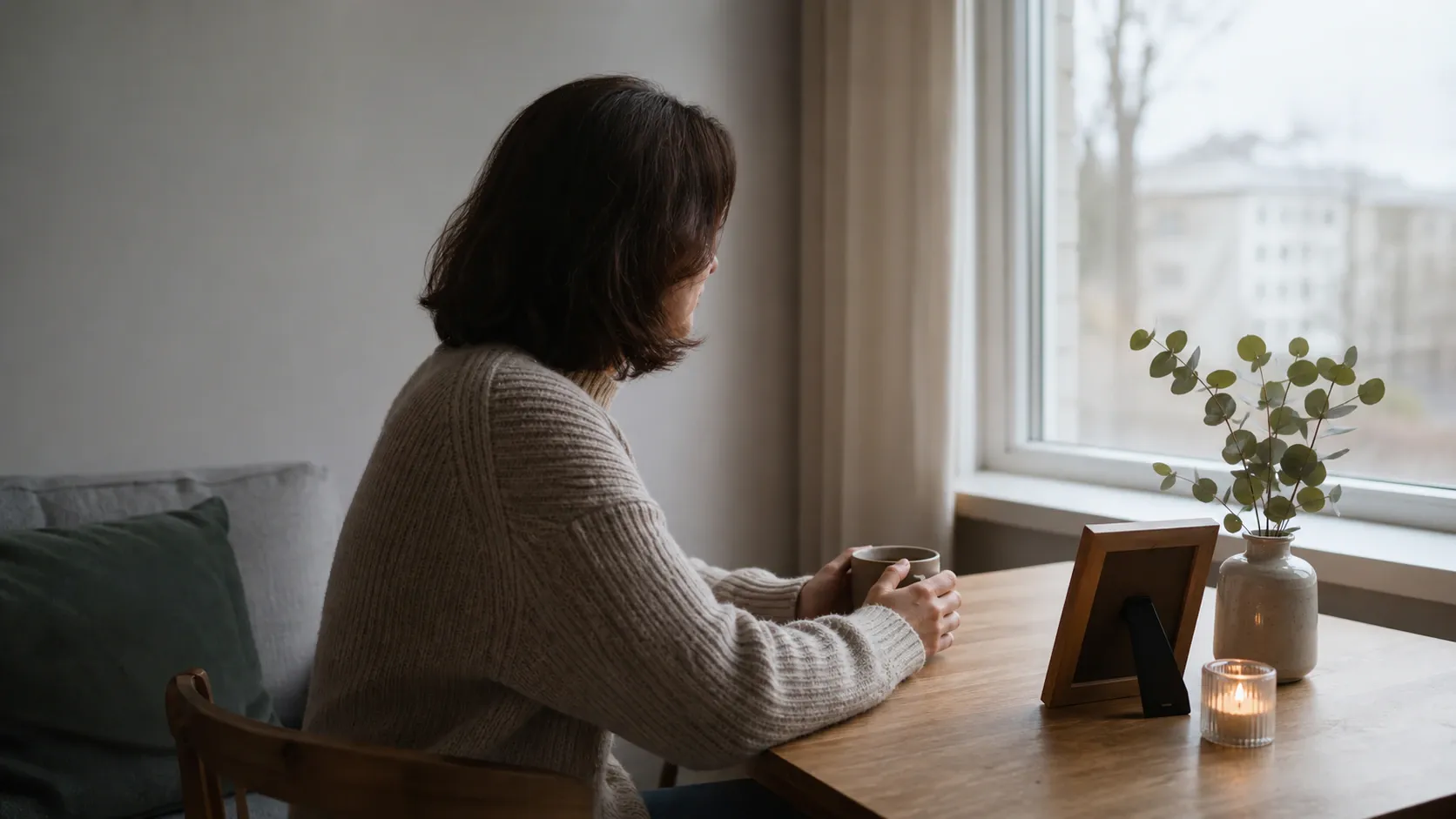

After a breakup, you may understand that the relationship is over and still instinctively reach for your phone to share something that happened during the day. An empty place at the table, a changed weekend or a familiar song suddenly brings that person to mind. Asking how to get through a breakup often means a very simple concern: how can I get through today and gradually have a life of my own again?
You can begin with a little support: look after your body, reduce the checking that hurts you and avoid carrying the whole burden alone. When a relationship ends, you do not have to feel free immediately or turn this period into a personal growth project. You can find your feet while still feeling sad.
The relationship has ended, but the feelings continue
You lose more than a person’s presence beside you. Your imagined future, familiar rituals and relationships with loved ones change. You may need to move, take on household matters you have not handled before or learn to be at home alone. Emotional pain becomes entwined with very practical everyday exhaustion. Even a decision that has developed over a long time does not prepare you for every consequence.
The NHS information on loss lists the end of a relationship as an experience that can bring grief. Sadness, anger, guilt or emotional numbness may shift and return unexpectedly. There is no compulsory sequence of stages. Relief one evening does not cancel out tears the next day; a harder day does not erase earlier improvement either.
If you felt lonely in the relationship for a long time, separation may bring both relief and longing. Both feelings can be part of the same experience. You may miss the closeness you hoped for, as well as the closeness that actually existed. Naming these distinctions can help you understand more precisely what you need now.
First, make the day manageable
When the future feels too large, reduce the scale of your planning. What will you need before this evening? What will you eat, when will you finish work, and who could stay in touch? The NHS self-help recommendations for low mood suggest keeping a daily rhythm, eating regularly, moving within your abilities and staying connected. These are general sources of support, rather than a treatment programme for separation.
You do not need to put the whole house in order if making dinner and changing the bedding is enough for today. At work, choose one essential task and plan a break if possible. If your home or income has changed, practical help from someone close may be just as necessary as a long conversation. Asking someone to go shopping with you is not weakness.
Notice your evenings too: endless browsing or alcohol can become ways of postponing an encounter with silence. Try arranging a short call in advance or preparing a simple activity. The aim is not to keep yourself busy all the time, but to have a choice when loneliness becomes hard to bear.
Boundaries with an ex-partner serve a purpose
Before writing, ask yourself: am I dealing with a practical matter or seeking brief reassurance? Arranging to collect a child and asking whether your ex-partner still misses you are different conversations. Where you have shared responsibilities, one clear channel, agreed topics and agreed times may help. Any arrangement should reflect real needs, including urgent matters involving children.
In T. C. Marshall’s study, more frequent checking of an ex-partner’s profile was associated with greater distress and longing after a breakup. This is an association, not proof that checking alone causes difficulties. The study mainly involved young people; it cannot establish a compulsory no-contact rule for everyone.
You can, however, examine your own experience: after seeing an update, is it easier to return to your day, or do you spend hours speculating? You can mute an account, hide photo reminders or ask friends not to share news for your own peace of mind. There is no need to rush to destroy memories. If there are threats or stalking, ordinary communication agreements are not enough: seek safety and specialist support first.
If you have children, a practical message might sound like this: ‘Please confirm whether you will collect our child at the agreed time on Friday. I will write separately about other matters.’ Discuss your pain with another adult so your child does not have to pass on messages or decide which parent is right. An ex-partner’s wish to talk at length does not oblige you to become their emotional support. You can politely say that, for now, you will discuss only essential matters.
How can you tell children about a separation?
What usually matters most to children is not the reason for the breakup, but what will change in their everyday life. The American Academy of Pediatrics recommends that, if possible, parents tell children together and calmly. The message should be clear and simple, without details of adult conflict that might lead a child to think they must fix everything or are somehow to blame.
Young children benefit from a familiar routine, consistent rules and extra closeness. They may need to hear more than once that the separation is not their fault and that both parents love them. Teenagers often want to know more about how their lives will change. Open, calm conversations, acknowledgement of their feelings and ordinary everyday expectations can help.
You could begin simply: ‘We have decided to live separately. This is a decision between adults, and it is not because of you. We both love you and will continue to be your parents.’ Your child may ask the same question several times later. This is natural: hearing answers again helps them make sense of their new everyday life.
When arrangements about children or maintenance are needed
Emotional recovery and practical arrangements often happen at the same time, so disputes over children’s residence or maintenance may repeatedly reopen the pain. In Lithuania, since 1 January 2020, family disputes such as divorce, child maintenance, children’s residence and contact arrangements have required compulsory mediation. If you apply to the State-Guaranteed Legal Aid Service, state-funded mediation may last up to eight hours.
A mediator does not decide for you, but helps you discuss specific arrangements and seek a solution acceptable to both of you. For legal questions in Lithuania, you can receive a free legal consultation of up to one hour through your municipality. If contact threatens your safety or your children’s safety, tell the professionals involved and prioritise safety.
When one evening seems to take you back to the beginning
Imagine a fictional situation. Rūta comes home from work and sees a photograph of her ex-partner. She thinks: ‘He is already fine, so I must have meant nothing.’ She wants to write a long message. Rūta pauses, puts the phone aside and notices that she has not eaten since lunch. She eats, calls a friend and says: ‘I do not need to judge his behaviour right now. Stay with me until the urge to write settles.’
The photograph has not changed, but there is now a space between the impulse and the action. ‘I meant nothing’ is a painful interpretation that one post cannot confirm. In your own situation, you can separate three things: what you actually saw, what you concluded about it and what you need now. You may need to cry, rest or be heard.
Even if you did send a message and felt worse, you do not need to punish yourself. You can end the conversation, return to your boundaries and notice the moment when you needed more support. One evening is not a verdict on your whole recovery.
You can understand the experience without replaying it endlessly
Asking ‘What could I have done differently?’ sometimes helps you learn. But it can become an endless process in which every memory is another accusation against yourself. Useful reflection leaves at least a little clarity or a specific next step. If all it leaves is a fresh urge to review everything again, it may be time to stop. I explore this distinction further in the article on thoughts that keep going round in circles.
In an experiment by D. A. Sbarra and colleagues, emotional writing about divorce was associated with poorer subsequent wellbeing for some participants prone to prolonged rumination, compared with a neutral writing task. This does not mean journals are harmful for everyone. It is worth evaluating writing by its effect on you rather than treating it as a compulsory healing task.
You could write down one need or lesson you have recognised and close the notebook. For example: ‘In the relationship, I kept quiet when I was hurt. In future, I want to say so earlier.’ In a 2022 study of self-compassion after divorce, higher self-compassion as rated by observers was associated with less subsequent distress. This does not guarantee a quick result, but it is a reminder that you can acknowledge mistakes without turning yourself into a bad person.

Getting to know yourself and your people again
After a long relationship, the question ‘What do I want?’ can feel unexpectedly difficult. In studies by E. B. Slotter and colleagues, breakups were associated with changes in self-concept and reduced clarity about it, and that uncertainty was linked to greater emotional distress. Shared everyday life becomes woven into how we describe ourselves.
You can explore your sense of self through small choices: what you want to eat, how you like to spend Sunday and with whom you feel at ease. You do not have to return to the person you were before the relationship. You can keep what you discovered and valued within it and try something there was previously no room for. An activity may not bring much joy at first; what matters is that you chose it. Read about the possibilities for this exploration in conversation in the article on a deeper understanding of yourself.
Tell the people close to you what support you need: listening, company or practical help. If mutual friends rush to take sides, you can ask them not to share your private conversations. A new romantic connection may also develop, but it does not have to prove you have recovered. Let yourself get to know someone at a pace that allows you to be honest with yourself and with them.
It is worth thinking ahead about upcoming holidays or weekends you used to share. You might spend part of the day with a friend, plan a short outing or create a small ritual of your own at home. You do not have to make the whole day pleasant. It is enough to know where you can take a breather and whom you will call if memories become more intense. You can ask for an invitation even if your partner used to take the lead in staying in touch.
You do not have to reach your lowest point to deserve help
Consider not only how much time has passed, but how you are living now. If sleeping, eating, working or caring for your children is difficult, or hopelessness is growing, seek a psychologist or your GP. Significant physical symptoms need medical assessment. If you have thoughts of harming yourself, seek urgent help; if life is in immediate danger or you cannot stay safe, in Lithuania call 112.
In an individual online session with a psychologist, you can discuss your own experience of separation, the hardest moments of the day and the support you need. You do not have to have a clear story or a final answer about why it ended. Sometimes the beginning is a sentence: ‘I am hurting, and it is too hard to carry this alone right now.’
Questions that arise after a breakup
How long does it take to recover after a breakup?
There is no single timeline. How you feel is affected by the meaning of the relationship, the circumstances of the separation, ongoing concerns and available support. It is more useful to notice whether there is more room for sleep, work, connection and rest. If everyday life is becoming increasingly difficult, seek support now rather than waiting for a set number of months.
Why does it hurt if I initiated the separation?
Deciding to end a relationship does not switch off attachment, shared memories or disappointment over hopes that did not come true. You may feel both relief and sadness. Pain alone does not prove the decision was wrong, and relief does not erase the relationship’s importance.
Do I have to stop all contact with my ex-partner?
There is no rule that suits everyone. If you have no shared responsibilities, a pause can give you space. If you have children or shared practical matters to manage, you can keep a clear channel for practical communication and agree on topics and times. If contact poses a threat, safety and individual specialist support come first.
What can I do if I keep checking my ex-partner’s social media?
Notice what prompts you to check and how you feel afterwards. You can mute the account, remove the shortcut and ask friends not to pass on updates. When the urge comes, first name what you are looking for: clarity, closeness or reassurance. Then choose another brief action, such as messaging someone supportive.
How can we communicate after separation when we have children?
As far as it is safe and possible, focus messages on the child’s specific needs, timings and agreements. A child should not carry messages between adults or comfort one parent about the other. Complex arrangements and safety concerns may require separate specialist support; this article is not legal advice.
How do we tell children about a separation?
If possible, tell them together with their other parent, calmly and simply. Explain what will change in their everyday life without sharing details of adult conflicts. Young children may need repeated reassurance that the separation is not their fault and that both parents love them. Teenagers often need more information and opportunities to ask questions.
Is mediation compulsory in divorce cases?
In Lithuania, compulsory mediation has been required since 1 January 2020 for family disputes such as divorce, child maintenance, children’s residence and contact arrangements. When an application is submitted to the State-Guaranteed Legal Aid Service, state-funded mediation may last up to eight hours. This is general information, not legal advice.
Does keeping a journal help after a breakup?
Writing helps some people make sense of their experience, but it is not a task for everyone. If writing leaves you increasingly caught in blame or replaying the same events, shorten it or take a break. You might write down just your current need and one immediate action. Discussing difficult experiences with a professional may be safer than repeatedly analysing them alone.
When can I start a new relationship after a breakup?
There is no compulsory waiting period. What matters is whether you are interested in the new person, can be honest about what you currently want and can respect both people’s boundaries. If dating is mainly about proving your worth to your ex-partner or avoiding every moment alone, it is worth slowing down and developing other sources of support.
When should I see a psychologist after a separation?
You can seek support whenever you want it. It is especially worth acting promptly if you struggle to sleep, eat, work or care for yourself or your children, feel increasingly hopeless or turn to alcohol more often. Discuss significant physical symptoms and health changes with a doctor. If life is in immediate danger or you cannot stay safe, call 112 in Lithuania, or your local emergency number elsewhere.
Sources used
- NHS. Grief after bereavement or loss (accessed in 2026).
- NHS. How to cope with depression (accessed in 2026).
- Marshall, T. C. (2012). Facebook Surveillance of Former Romantic Partners: Associations with PostBreakup Recovery and Personal Growth.
- Sbarra, D. A. et al. (2013). Expressive Writing Can Impede Emotional Recovery Following Marital Separation.
- Chau, R. F. et al. (2022). Emotional recovery following divorce: Will the real self-compassion please stand up?
- Slotter, E. B., Gardner, W. L., Finkel, E. J. (2010). Who am I without you? The influence of romantic breakup on the self-concept.
- American Academy of Pediatrics, HealthyChildren.org. How to Talk to Your Children about Divorce (updated in 2020).
- State-Guaranteed Legal Aid Service, Lithuania. Compulsory mediation (accessed on 28 September 2026; in Lithuanian).
- State-Guaranteed Legal Aid Service, Lithuania. Free legal consultation (primary legal aid; in Lithuanian).
You can find your feet at your own pace
If you need support after a breakup, you can begin with a conversation about what feels hardest today.
Book a session