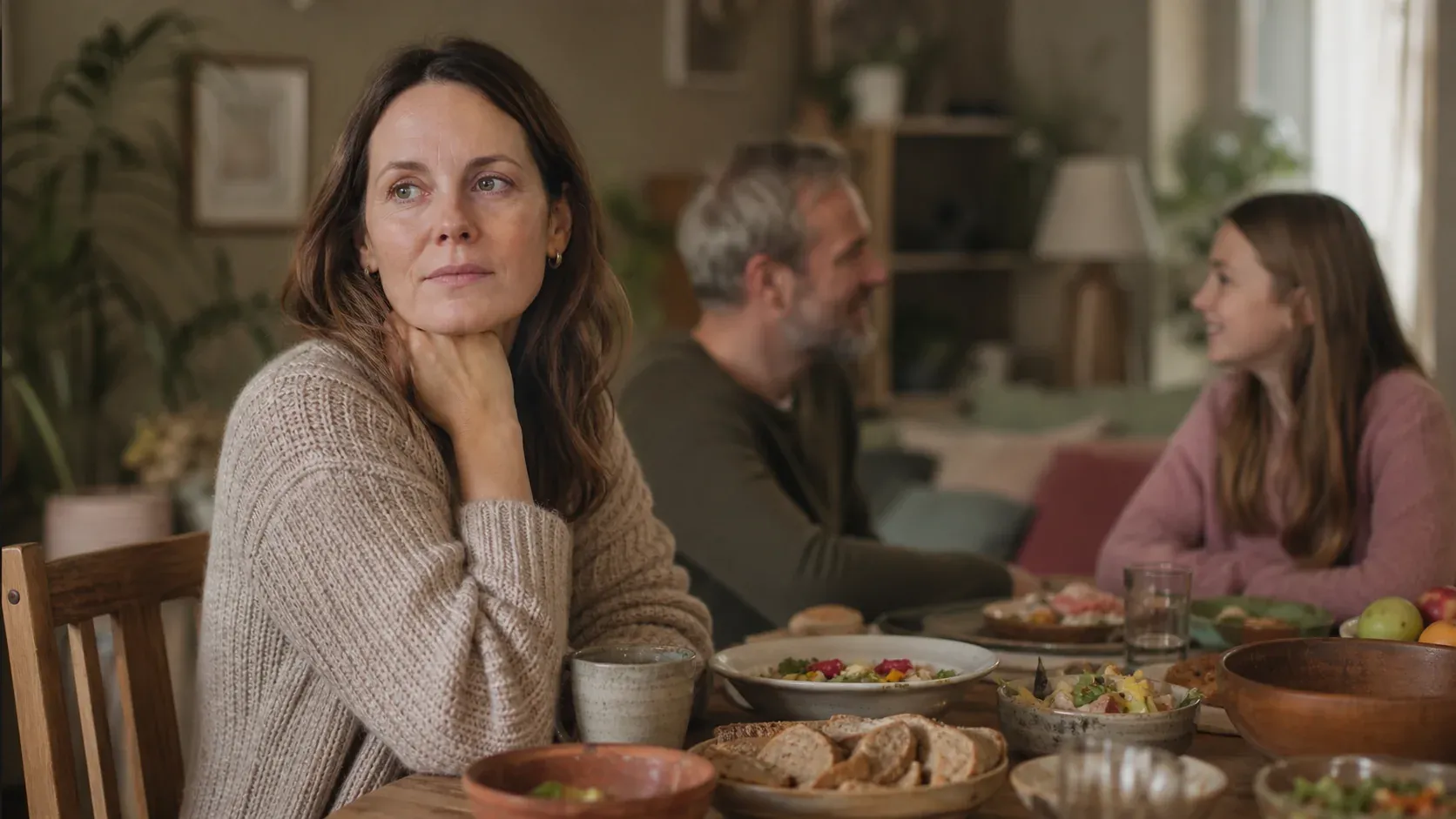

An empty nest: the children leave, and the house grows quiet. We often talk about children leaving home as though it were simply a lovely, natural stage of life. In one sense, it is a sign of a child’s maturity and growth. Yet for a mother, it can also bring a deeply tender sense of loss.
Suddenly there is less noise at home. Fewer worries. Fewer everyday cries of “Mum, where’s…?” If daily life has revolved around caring for children for many years, questions may arise: “Who am I now?”, “How will I fill this emptiness?”, “Why is this so hard when I should be happy for my child?” If this sounds familiar, know that these feelings do not mean something is wrong with you. You can be proud of your grown children and miss them deeply. You can welcome their independence and grieve an earlier stage of life. Mixed feelings do not mean you are ungrateful or unable to let go.
The empty nest period can be both a farewell to what came before and an invitation to rediscover yourself. Gradually, you can learn to:
- accept feelings as they arise without suppressing them;
- build a life that feels full again, with care for yourself as well as others;
- discover your own needs, wishes and dreams;
- look afresh at relationships, friendships and your identity.
Sometimes this requires a safe space to be with what you are experiencing, rather than trying harder to “get yourself together”. If your home is quieter than it used to be, perhaps it is time to hear yourself too.
In this article, I explain what the empty nest period means, why research describes different parental experiences, how to stay close to an adult child and when to seek support.
At a glance: what matters about an empty nest?
- “Empty nest syndrome” is a popular description of feelings during a particular stage of life, rather than a clinical diagnosis.
- When a child leaves, longing, sadness, pride and relief can coexist.
- This life transition is different from a loved one’s death, although some feelings may overlap.
- Clear agreements, respect for privacy and mutual boundaries help maintain connection with an adult child.
- If you do not begin to feel better over time, or daily life becomes difficult, it is worth speaking with a psychologist or GP.
What is empty nest syndrome?
Empty nest syndrome is an everyday term for the feelings and difficulties that may arise when a child leaves to live independently. The word “syndrome” can sound medical, but it is important to be clear: this is not an official mental health diagnosis or a disorder that every parent experiences.
It is better understood as a life transition in which family structure, daily rhythms, caregiving tasks and part of your identity change. Some people find it painful, others experience more freedom, and many experience both.
Why can children leaving home feel so sensitive?
After many years of parenting, daily life is often organised around children’s needs: school, food, lifts, conversations, care, decisions and constant watchfulness. When these tasks suddenly decrease, more than the noise level at home changes. You need to reconsider who you are and what a day looks like when you no longer have to be available as often.
Your role and identity as a parent change
If much of your sense of self has been tied to caring for others, children leaving can raise the question: “Who am I now?” This does not mean you have lived your life wrongly. An important role has simply changed, and you need time and space to discover other parts of yourself: partner, friend, professional, creator, learner or simply someone with wishes of your own.
Your relationship with your adult child changes
Everyday contact gives way to messages, calls, weekend meetings or less frequent visits. Your adult child may make decisions you do not always agree with and ask for help less often. Parents have to learn to remain present and connected without taking control.
A quiet home can bring difficulties in your relationship or other connections into focus
When children’s needs no longer fill the day, a couple may find themselves alone together for the first time in years with matters previously put aside: unspoken grievances, loneliness in the relationship, different views of the future or questions about how to live from here. This does not always mean the relationship is doomed; sometimes it is an invitation to reach new agreements and get to know each other again.
An empty nest brings more than sadness: what does research show?
Research does not support a single universal story in which every parent’s wellbeing necessarily worsens when children leave. A 2024 review in Communications Psychology describes two processes that can operate together: losing a role may reduce wellbeing, while reduced daily caregiving pressure may allow more time, energy, social life and satisfaction. Culture, family roles, gender norms, the quality of the parent-child relationship and social support all shape how this stage is experienced.
A 2024 analysis of a German longitudinal study also suggests that it matters whether the first child or the last child leaves. This reminds us that an “empty nest” is not one event with a single predictable reaction. Your experience depends on your family history, living circumstances and what this change means to you.
Missing them and a sense of loss
- missing everyday conversations,
- the house feels unusually quiet,
- sadness or emptiness arises,
- wishing you could return to the old routine.
Relief and more space
- fewer everyday worries,
- more time for sleep and rest,
- a chance to return to interests put on hold,
- less constant pressure of responsibility.
Pride and growth
- enjoying your child’s independence,
- a new relationship between adults grows stronger,
- an opportunity to rediscover yourself,
- a chance to create different family traditions.
Anxiety and loneliness
- worrying about your child’s safety or choices,
- struggling to find ways to fill the day,
- fewer social contacts,
- finding it harder to communicate with your partner.
There is no single right way to experience this stage
You can miss your child deeply and enjoy a quieter home. You can be proud of their independence and feel that you have lost part of yourself. Mixed feelings do not mean ingratitude, weakness or a lack of love for your child.
An empty nest or grief after bereavement?
When a child leaves, you may feel a real sense of loss: the familiar changes, and you say goodbye to one stage of family life. Still, this is different from grieving a loved one’s death. With an empty nest, your relationship continues, allowing you to create a new way of relating: moving from daily caregiving towards a relationship between adults. After a death, adjustment involves the person’s irreversible physical absence.
| Children leaving home | A loved one’s death | |
|---|---|---|
| What changes? | Daily presence and your parenting role; the relationship can continue in another form. | The person’s physical absence and the irreversible loss of the relationship as it was. |
| Possible feelings | Longing, emptiness, pride, relief, anxiety and freedom. | Sadness, longing, anger, guilt, numbness, relief and other grief responses. |
| The direction of adjustment | Building a new adult-to-adult relationship and a new balance in daily life and identity. | Learning to live with the loss while preserving connection through memories and meaning. |
These experiences may overlap, especially if a child’s departure coincides with divorce, illness, retirement or another loss. Rather than labelling yourself, it matters to notice what is happening to your wellbeing and what could help you move through the change more safely.
When is adjustment difficult enough to seek help?
Sadness alone does not mean illness. However, it deserves attention when your wellbeing does more than fluctuate: it does not improve over time, increasingly narrows your life or interferes with everyday activities. These signs are not a way to diagnose yourself, but they may be reasons to consult a psychologist, psychiatrist or GP:
- for several weeks or longer, you feel hopeless, highly anxious or empty almost all the time;
- sleeping, eating, working, completing daily tasks or caring for your health becomes difficult;
- activities that used to matter no longer interest you, and you increasingly withdraw from others;
- the empty nest repeatedly triggers conflict with your partner or adult child;
- you begin using alcohol or medication more often, or look for other ways to numb how you feel;
- you have thoughts of no longer wanting to live or of harming yourself.
When should you not wait?
If you have suicidal thoughts or an urge to harm yourself, feel unsafe or worry about someone else’s safety, in immediate danger in Lithuania, call 112 or go to the nearest emergency department. In Lithuania, Vilties linija offers emotional support for adults around the clock on 116 123.
How can you support yourself after children leave?
The aim is not to “fill” the silence as quickly as possible or pretend that the change does not affect you. Gradually, you can build a life in which your children still have an important place, while no longer being the sole centre of your identity and daily rhythm.
Allow yourself the full range of feelings
You do not have to choose between happiness for your child and sadness about your changed life. Name what is happening: “I’m proud of my child, and I miss them too.” Acknowledging this reduces the need to pretend it is all easy.
Create new anchors in your day
When familiar caregiving tasks disappear, free time may initially feel unsettling rather than enjoyable. Begin with small actions: a sleep routine, a walk, an activity you had put aside or a new plan for the week.
Protect the connection without losing yourself
Discuss how you would like to keep in touch, while leaving room for your child’s independence. If you want to keep checking that everything is all right, it is better to share that anxiety with another adult or a psychologist than to make reassuring you your child’s responsibility.
Renew other relationships and roles
The empty nest stage can be an opportunity to return to friendships, your relationship as a couple, work, learning, volunteering or creativity. The aim is not to “fill the emptiness with anything”, but gradually to reclaim a life in which you are more than a mother or father.
Adult children and boundaries: how can you maintain closeness?
A child leaving home does not mean the relationship has ended. It becomes more mutual: your adult child has their own home, decisions, relationships and right to privacy, while you remain important without directing daily life. This transition can feel sensitive for both of you.
Make agreements instead of guessing
Ask openly: “How often would you like us to keep in touch?” or “What works best for you: a call, a message or meeting up?” A specific agreement reduces waiting and disappointment, but allow it to change as circumstances change.
Talk about missing them without making them feel guilty
You can say “I miss you”, but avoid “You don’t care about the family” or “After everything I’ve done for you”. Your feelings are real, but your adult child should not be responsible for making them disappear. It helps to have more than one source of support for longing and anxiety: a partner, friend, community or psychologist.
Accept that closeness may look different
Sometimes contact decreases because life has changed, rather than because there is less love. A shared activity, tradition or regular conversation can help preserve connection without returning to former patterns of control.
When your child moves abroad
Sometimes a child leaves to study or work in another country. Distance, time differences, concern for their safety abroad and the prospect of rare visits can add to the longing. Sometimes uncertainty is hardest: whether they will return, what their life will look like and what place you will have in it.
Agree on a rhythm of contact that suits you both
Take into account the time difference, your child’s work or study schedule and your own routine. A short message several times a week and a longer video call at the weekend may work better than spontaneous calls at inconvenient times.
Plan visits in advance
Knowing when you will next meet can make the distance easier to bear. Discuss who will visit whom, how long you will spend together and how you will mark holidays when you cannot meet.
Show interest without taking control
Ask about your child’s daily life, friends and the city where they live. Discuss worries about their safety abroad with another adult or a psychologist, so that reassuring you does not become your child’s responsibility.
Build support where you are
Distance can reveal how closely your daily life was tied to your child. Friendships, meaningful activities and community help keep life from becoming only a wait for contact. Read about simple everyday sources of support in the article everyday activities as self-care. If your child is also struggling abroad, they may be able to access an online consultation with a psychologist in Lithuanian.
When an adult child moves back home: the “boomerang” stage
Leaving home does not always follow a straight line. The term boomerang kids describes adult children who move back in with their parents after moving out. Research links these moves to economic circumstances, work, study, relationship changes and mental health difficulties. It is neither a failure of parenting nor proof that a child is “spoilt”.
Their return may bring relief, happiness and anxiety at the same time. To prevent living together from becoming an indefinite return to old family patterns, it helps to discuss in advance:
- the timeframe: when you will review the situation and what you are working towards;
- finances and household tasks: expenses, chores, food and shared rules;
- privacy: rooms, guests, time together and time apart;
- responsibility: how you will help without solving everything for your adult child;
- the next step: which practical actions will help your child move towards independence.
Boundaries are not the opposite of love. Clarity protects both parents and adult children from hurt, unspoken expectations and a constant sense that someone owes someone else something.
When can a consultation with a psychologist help?
Psychological support can help before “everything is very bad”. A consultation offers a safe space to name what has really been lost, distinguish longing from guilt, understand why letting go of control is difficult, discuss relationships with your partner or adult child and discover which parts of your own life you would like to reclaim.
If you would like to talk about this, you are welcome to book a psychological consultation. Iveta Litvinienė offers adult consultations online via Teams in Lithuanian and English. To explore whether it is time to seek help, read when to see a psychologist. You can learn about the format on the online psychological consultation page, and the consultation fees page provides current prices and payment terms. You can choose a consultation time on the booking page.
Frequently asked questions about an empty nest
What is empty nest syndrome?
Empty nest syndrome is a popular term for the feelings that may arise when a child, or the last child, leaves home: sadness, longing, emptiness, anxiety or feeling lost. It is not a clinical diagnosis, and not every parent finds this stage difficult.
Is it normal to feel sad even though I am proud of my child?
Yes. Pride in your child’s independence, longing, sadness, relief and anxiety can all exist at once. Mixed feelings do not mean you cannot let go or are not happy about your child’s life.
How long does the empty nest period last?
There is no fixed timescale. Adjustment depends on your relationship with your child, the intensity of daily caregiving, your relationship as a couple, social support, your previous wellbeing and other life changes. What matters more than the number of weeks is whether you are gradually regaining the ability to live your life, rest and care for yourself.
Does an empty nest mean depression?
No. An empty nest is not a diagnosis of depression. However, persistent hopelessness, loss of interest, changes in sleep or appetite, marked isolation and difficulties with daily functioning may indicate depression or another difficulty worth assessing with a mental health professional.
How can I stay close to my adult child without taking control?
It helps to agree on a pattern of contact that suits you both and respect your adult child’s privacy. You can say you miss them, but should not demand more frequent replies or make them feel responsible for your mood. Connection grows when there is room for both closeness and independence.
What if my adult child moves back home?
Returning home is not a failure. It may relate to study, work, housing costs, relationship changes or a need for temporary support. Calmly discuss the timeframe, finances, household tasks, privacy, responsibilities and a date to review the arrangement. Clear boundaries help protect the relationship.
When is it worth seeing a psychologist about an empty nest?
It is worth seeking help if the feelings do not ease over time, interfere with sleep, work or self-care, seriously affect relationships, lead to increasing withdrawal or leave you unsure how to fill your life. You can also seek help earlier simply because you want a safe space to understand this change.
Can I have online consultations about an empty nest?
Yes. If you are not in an acute crisis, an online consultation with a psychologist via Teams can be a convenient way to talk about children leaving home, changes in identity, relationship boundaries, sadness and a new stage of life. Iveta Litvinienė offers consultations in Lithuanian and English.
Sources and guidance
- Hartanto, A. et al. (2024), Cultural contexts differentially shape parents’ loneliness and wellbeing during the empty nest period, Communications Psychology
- Collischon, M., Eberl, A. and Wolbring, T. (2024), Parental well-being when children move out: A panel study on short- and long-term effects, Advances in Life Course Research
- Cleveland Clinic (2024), What Is Empty Nest Syndrome? How To Cope
- Sandberg-Thoma, S. E., Snyder, A. R. and Jang, B. J. (2015), Exiting and Returning to the Parental Home for Boomerang Kids, Journal of Marriage and Family
- NHS, Grief after bereavement or loss
Your life does not end when your children leave
An empty nest can be a tender farewell to one stage of family life and the beginning of a life with more room for you. If this change feels difficult to navigate alone, a conversation with a psychologist can offer a safe space to understand your feelings and discover further support.
Book a consultation