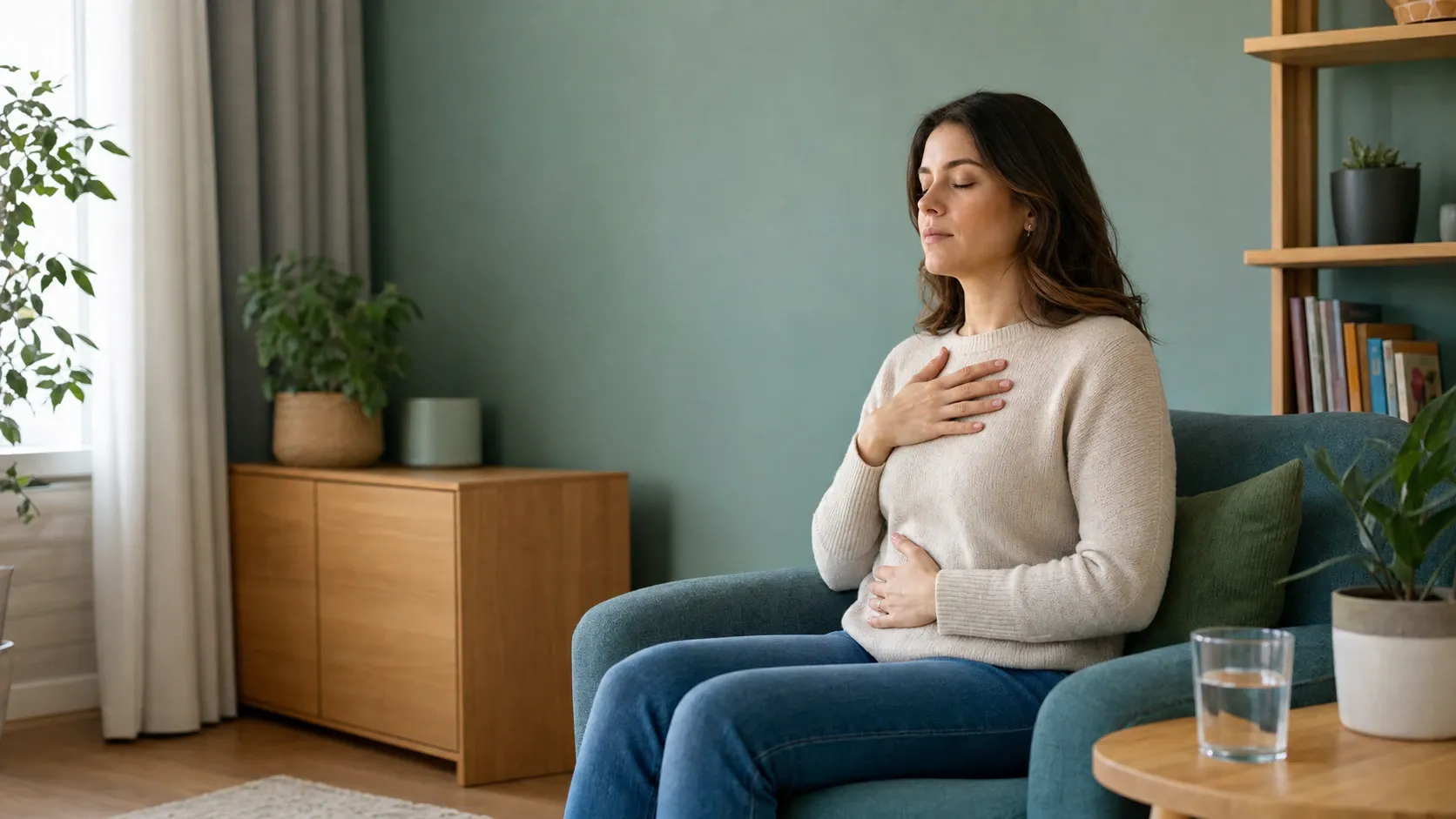

It is quiet around you, your work is done and your loved ones are safe, yet your body is still tense and your mind is searching for what might happen. This anxiety is not proof that you are ungrateful or ‘do not know how to relax’. Sometimes danger is no longer present, but your internal protective system has not yet settled into a calmer state.
Persistent anxiety may be related to prolonged stress, a habit of expecting the worst, uncertainty, lack of sleep, earlier experiences or physical health factors. It does not necessarily mean an anxiety disorder. It matters to consider the whole picture: how long the feeling has lasted, whether the worry is hard to manage and how it affects sleep, work, relationships and everyday decisions.
At a glance: why does anxiety persist when everything is fine?
- the anxiety system responds not only to current danger, but also to perceived threats and earlier experience;
- monitoring the body, repeated checking, reassurance-seeking and avoidance may bring brief relief while sustaining the anxiety cycle over time;
- background anxiety differs from a sudden panic attack, although both can occur together;
- persistent anxiety alone is not a diagnosis: duration, symptoms, distress and the effect on daily life all need to be considered;
- new or significant physical symptoms are worth discussing with a GP, and a distressing anxiety cycle with a psychologist.
What happens when things are calm around you, but not inside?
Anxiety is a protective response that helps prepare you for possible danger. It can be useful before an important conversation, an exam or genuine uncertainty. After a long period of strain, however, the body may remain alert even when the situation has changed. In quiet moments, it can even be easier to hear thoughts and feel physical tension that the day’s tasks had drowned out.
Worrying sometimes becomes an attempt to prepare for every scenario: ‘If I think everything through, nothing will catch me by surprise.’ But uncertainty cannot be removed completely. The more often the mind searches for absolute certainty, the more easily thoughts begin to go round in circles.
How can you distinguish situational worry, persistent anxiety and panic?
The comparison below is intended as a guide, not a tool for self-diagnosis. These experiences can overlap, and similar symptoms may have different causes for different people.
| Experience | What is usually characteristic? | What matters to assess? |
|---|---|---|
| Ordinary situational worry | Linked to a specific problem and usually eases when it ends or a decision is made. | Is the worry proportionate to the situation, and can you still return to other activities? |
| Persistent background anxiety | Tension and apprehension move from one subject to another; it is hard to relax or stop the flow of thoughts. | How long has it lasted? Does it affect sleep, attention, relationships or work, and does it lead to avoidance? |
| A panic attack | A sudden wave of intense fear or discomfort with marked physical sensations, usually reaching its peak within minutes. | Are the symptoms familiar, and could there be an acute medical emergency? Read more about panic attacks and what can help during them. |
| Possible medical or substance-related influences | The anxiety is new, unusual, strongly physical or began alongside changes in health, medication or substance use. | An assessment by a GP, or emergency care for acute, dangerous symptoms. |
What can keep the anxiety cycle going?
Anxiety often persists because of interconnected thoughts, physical reactions and behaviours rather than one single cause. This is not your fault or a conscious choice. Recognising the cycle creates more room for small changes.
Looking for threats
Attention automatically turns to what might go wrong. Even a neutral email, a quiet evening or a bodily sensation may be interpreted as a warning.
Monitoring bodily sensations
Tension, a faster pulse or more difficult breathing are noticed sooner. Becoming frightened of these sensations sends the body another signal of danger.
Seeking reassurance
Checking, asking ‘Is everything really all right?’ or searching for symptoms online can bring brief relief, but may weaken confidence in your ability to sit with uncertainty.
Avoidance
Cancelling a trip, a conversation or another anxiety-provoking activity brings relief. Over time, however, your brain misses opportunities to learn that you can cope with the situation.
Does persistent anxiety mean I have generalised anxiety disorder?
No. Generalised anxiety disorder is a clinical diagnosis, not another name for stronger anxiety. Assessment considers whether someone worries excessively about different areas of life, finds the worry difficult to control and experiences it on most days. NIMH information and NICE guidance for assessing adults refer to a duration of at least six months, along with restlessness, fatigue, difficulty concentrating, irritability, muscle tension or sleep difficulties.
A professional looks beyond the calendar or the number of symptoms. It matters how much anxiety limits functioning and whether depression, panic, the effects of trauma, substance use or health problems are also present. The signs described in this article do not confirm a diagnosis, and you can seek help without waiting six months.
Could anxiety have a physical cause?
Yes. Changes in thyroid function, heart rhythm disturbances, low blood glucose, some medicines, large amounts of caffeine, psychoactive substances or alcohol withdrawal can produce symptoms that resemble or intensify anxiety. This does not mean everyone needs every possible test. Your GP can help decide what is worth checking based on your symptoms, medical history and medication.
When should you act without delay?
In Lithuania, call 112 if you suddenly develop severe or unusual chest pain, fainting, marked shortness of breath, sudden weakness on one side of the body, difficulties with speech or consciousness, or another acute health emergency. If anxiety is accompanied by thoughts of suicide or self-harm, or you do not feel safe, do not wait for a scheduled session either: in Lithuania, call 112 or go to the nearest emergency department. Outside Lithuania, use your local emergency number. In Lithuania, round-the-clock emotional support for adults is provided by Vilties linija on 116 123; more contact details are available in the Lithuanian national ‘Pagalba sau’ website’s directory.
What can you do when anxiety will not let go?
The aim of self-help is not to force yourself to calm down immediately. The demand ‘I must not feel anything’ can become another struggle. It is more useful to practise noticing anxiety, staying in the present and choosing actions according to what matters, rather than only trying to escape an uncomfortable feeling as quickly as possible.
Name it rather than arguing with it
Tell yourself: ‘I feel anxious right now, but a feeling is not proof that I am in danger.’ The aim is not to remove the feeling immediately, but to distinguish it from a fact.
Return to the present
Notice your feet and the support behind your back, name a few things you can see and breathe comfortably, making the out-breath slightly longer. If the exercise irritates you, try walking slowly or observing your surroundings instead.
Check whether the worry is something you can act on
Ask: ‘Can I take one specific action today?’ If so, plan it. If not, recognise it as a hypothetical scenario that does not need an answer right now.
Reduce habits that keep anxiety going
Notice caffeine, sleep, symptom checking and avoidance. Change one thing at a time and return gradually to activities that make you anxious but are safe, without forcing yourself.
Regular sleep and meals, movement, and less alcohol and caffeine may help reduce general vulnerability to anxiety, but this is not a promise or a treatment for every cause. If you also feel constantly exhausted, it may help to read about why tiredness persists even when everything seems fine on the outside.
When worries mainly concern bills, income or debt, it helps to look more specifically at anxiety about money and financial stress. In the article on this situation, I explore both real financial difficulties and the shame and avoidance that may accompany them.
When is professional support worth seeking?
It is worth seeking support if anxiety keeps returning, is hard to manage, disrupts sleep or attention, makes you give up important activities or constantly seek reassurance, or makes relationships and work more difficult. In a psychological session, you can explore your particular anxiety cycle, learn to tolerate uncertainty, respond differently to thoughts and physical sensations, and safely reduce avoidance. Interventions based on cognitive behavioural therapy have the strongest evidence in the treatment of anxiety disorders; the specific approach is chosen after an individual assessment.
If you have questions about physical causes or medication, contact your GP. If you would like to discuss the psychological factors in your anxiety, you can book an online session with a psychologist. Read more about deciding to seek support in the article ‘When is it worth seeing a psychologist?’, and choose a session time on the booking page.
Frequently asked questions about persistent anxiety
Why do I feel anxious for no clear reason?
Anxiety may be sustained by prolonged stress, a habit of staying alert, difficulty tolerating uncertainty, lack of sleep or earlier experiences. Physical health, medication or substance use can sometimes play a part too, so there is no single universal cause.
Does persistent anxiety mean I have generalised anxiety disorder?
Not necessarily. An assessment considers whether you worry about many areas of life, whether the worry is hard to manage, how long it has lasted and how it affects daily life. A diagnosis is made by a qualified professional, not by a single sign or an online test.
How is persistent anxiety different from a panic attack?
Persistent anxiety more often feels like background tension lasting hours or days. A panic attack is a sudden, intense wave of fear or discomfort, usually reaching its peak within minutes. The two experiences can occur together.
How long does anxiety have to last before it is a problem?
Assessments for generalised anxiety disorder often refer to hard-to-control worry occurring on most days for at least six months. However, you do not need to wait six months if anxiety is already distressing, disrupting sleep, work or relationships, or leading you to avoid things.
Can caffeine, medication or physical illness make anxiety worse?
Yes. Thyroid problems, heart rhythm disturbances, low blood glucose, some medicines, caffeine, psychoactive substances or alcohol withdrawal can mimic or intensify anxiety symptoms. Discuss new or unusual anxiety with your GP.
What can I do when anxiety does not go away?
Name what you are experiencing, slow your breathing, notice where your body is supported and distinguish a specific issue from hypothetical scenarios. Notice sleep, caffeine, avoidance and reassurance-seeking. If anxiety is limiting your life, seek a professional assessment.
When should I see a GP about anxiety, and when a psychologist?
A GP is important when symptoms are new, strongly physical or began after a change in medication. A psychologist can help when thoughts, avoidance, uncertainty or prolonged stress are keeping anxiety going. These approaches often complement each other.
Are online sessions with a psychologist suitable for persistent anxiety?
In many cases, yes. An online session can help you explore the anxiety cycle, learn different ways of responding to thoughts and sensations, and plan changes in behaviour. It does not replace emergency care when health or life is in immediate danger.
Sources and guidance used
- World Health Organization: Anxiety disorders (signs and approaches to support)
- National Institute of Mental Health: Generalized Anxiety Disorder
- NICE CG113: Generalised anxiety disorder and panic disorder in adults
- MedlinePlus: Anxiety (medical and substance-related causes)
- NHS: Generalised anxiety disorder (recognition and treatment)
- ‘Pagalba sau’: anxiety signs, forms and professional support in Lithuania [in Lithuanian]
Feeling anxious in a calm setting is not a personal failure
Your internal protective system does not always settle at the same time as your circumstances. You do not have to prove that things are ‘hard enough’ or wait until anxiety narrows your life. A conversation can help you understand what keeps it going and what small, realistic step could be useful now.
Book a session